
It’s often remarkable how nations with tiny landmasses yank the chains of larger nations in geopolitics. It’s the 1st of March, 2026, and the recent United States-Israeli attacks on Iran have further extended the days of no peace and quiet in the region. Before you continue reading, this is a very simplistic1 view of geopolitics.
Looking at Israel and Iran geographically and historically, it would make sense that Iran should be the neighbourhood bully. But this isn’t the case because Israel has some really (un)explainable2 bond with the United States who would stop at nothing to help her crush any enemies. Israel also ‘reportedly’ has nuclear weapons, which is the one other thing that has perpetually given them the edge over Iran. On the other hand, three countries away, Iran has probably every other thing they want except for nuclear weapons. This is the one thing both the United States and Israel have sworn to never let them have.
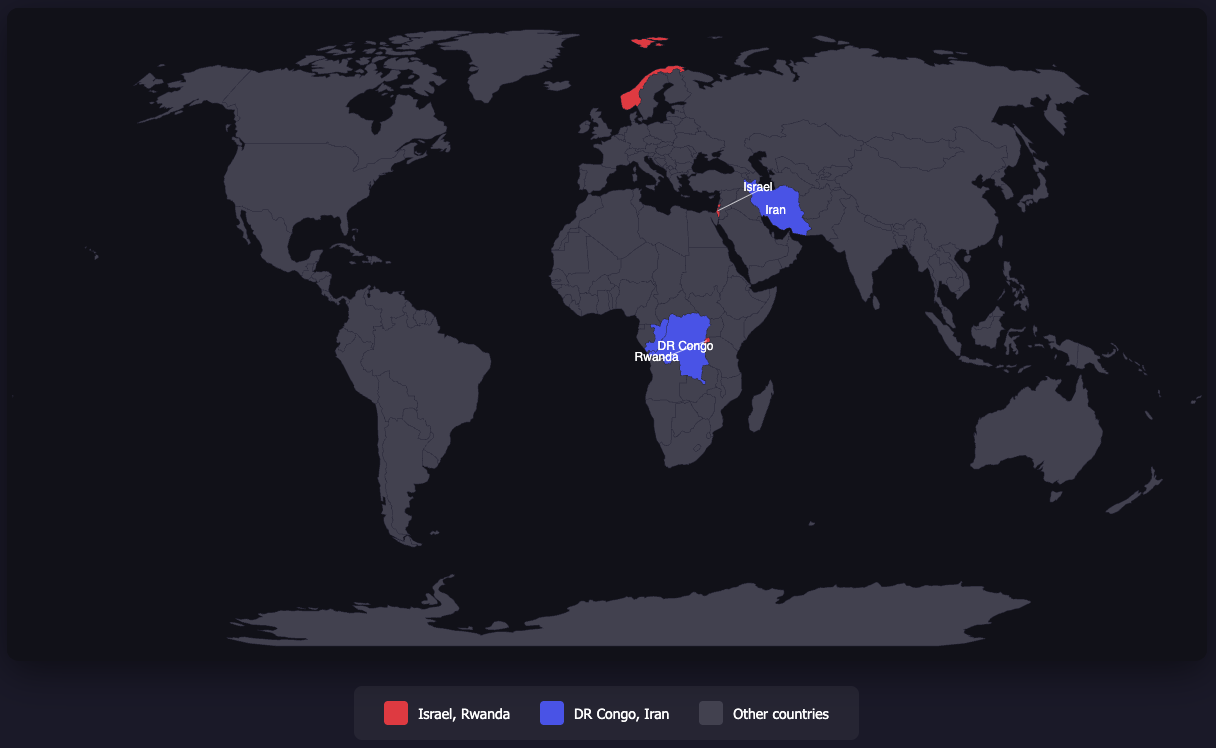
This post was to talk about Israel and Rwanda, actually, and how much of a thorn in the flesh they’ve been to the much larger Iran and the DR Congo, respectively. Ordinarily, I would sneak in a laugh for using that idiom in this context, but these are serious conflicts that have endured for a long time. And while their objects of conflict may not be the same, lives have been lost in both cases. The DR Congo – Rwanda conflict3 is a very delicate discussion that traces its roots even back to the 1994 genocide in Rwanda.
As someone who loves spending some time looking at maps and pondering geographical boundaries, I thought the best way to sell what I’m talking about is to show you these four nations on the global map. And that brings me to the end of this short observation, for now.
- Does not consider the intricacies of geopolitics, such as military strength, alliances, economic leverage, and internal stability. ↩︎
- Israel’s relationship with the United States is anything but unexplainable. Both nations have decades of strategic and political partnership. ↩︎
- Both nations signed a peace deal in 2025, chaired by the United States. ↩︎
 The Living Planet